Why Your Gratitude Practice Isn't Sticking (And the Ledger Method That Fixes It)
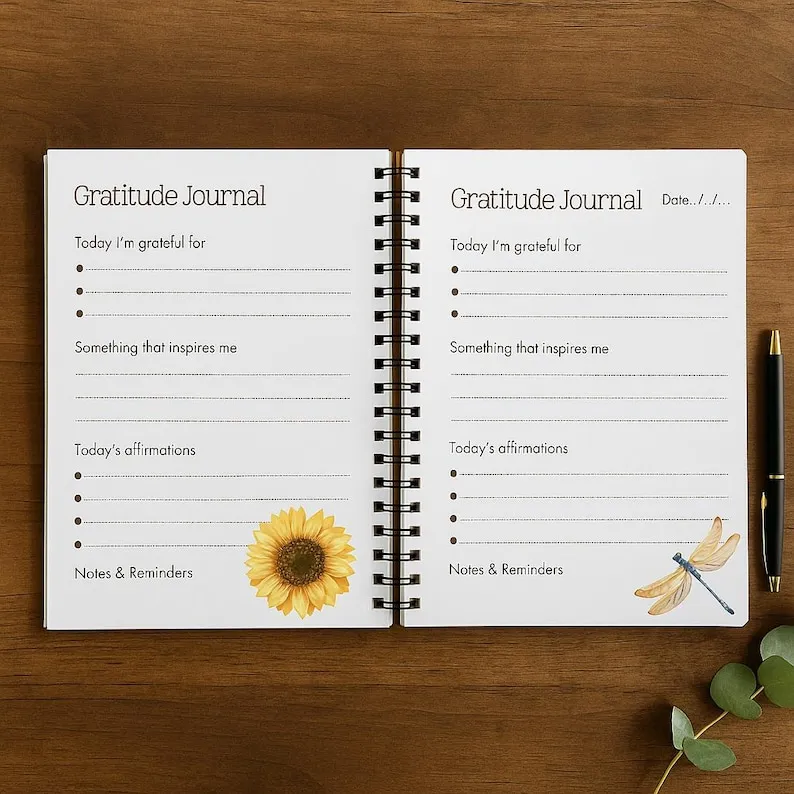
Photo: open gratitude journal notebook with pen on nightstand warm morning light, via i.etsystatic.com
You've probably tried gratitude before. Maybe someone told you to 'just count your blessings' or repeat a morning affirmation. It felt good for a day or two, then faded like a New Year's gym membership.
Here's the thing: the problem usually isn't your attitude. It's your method. There's a big difference between thinking something you're thankful for, saying it out loud, and writing it down — and the research says the third one is where the magic happens.
Thinking vs. Speaking vs. Writing: Not the Same Workout
Think of gratitude like exercise. Mental reflection is like watching someone lift weights — the intention is there, but the muscle doesn't get the message. Spoken affirmations are closer to a light warm-up: better than nothing, but easy to do on autopilot.
Writing is the actual rep.
When you put pen to paper, several things happen at once:
- Slower processing. Writing by hand forces you to move at roughly a third the speed of thought. That slowdown means you actually sit with the memory instead of skimming past it.
- Deeper encoding. Studies on expressive writing — including work popularized by researchers like Robert Emmons at UC Davis, who ran some of the foundational gratitude journaling studies — suggest that people who wrote weekly gratitude entries reported more optimism and fewer physical complaints than groups who merely thought or talked about them.
- A physical record. Your brain knows the difference between a thought that evaporated and a page that's still sitting on your nightstand. That ledger becomes evidence against your own bad days.
Psychologists sometimes call this 'effortful elaboration' — the small amount of friction required to write something down is exactly what makes the emotion stick. Spoken words can be mindless. Written words demand a tiny bit of work, and that work is the point.
The Gratitude Ledger: A Template You Can Start Tonight
Forget the fancy journals with gold foil covers. All you need is a notebook and five minutes. Here's the simple format we recommend:
The nightly entry:
- Date
- Three entries — each one gets a what, a who, and a why. Example: 'The barista remembered my order (what). Her name is Dana (who). It made me feel like a regular instead of a stranger (why).'
- One line of proof — a sentence describing how the moment actually felt in your body.
That third bullet is the part most people skip, and it's the part that matters most. Naming the feeling — warm, relieved, seen — is what converts a pleasant memory into a stored positive emotion.
The 'who' matters too. Gratitude entries that name another person tend to hit harder than entries about objects. 'My sister called' beats 'tacos' — though we're not knocking tacos.
Your 30-Day Progressive Plan
Don't worry about being profound. Worry about being consistent. Here's how to build the habit in stages:
Week 1 — The Basics (Days 1–7): Three entries per night, using the template above. Keep each one under two sentences. The goal is just showing up.
Week 2 — Go Smaller (Days 8–14): Ban the big three (family, health, home) for the week. You have to find gratitude in smaller things: the exact right amount of coffee left in the pot, a green light when you were late, a text from an old friend.
Week 3 — Add Depth (Days 15–21): Each night, pick one entry and expand it to a full paragraph. What would have happened if this person or moment hadn't shown up? This 'subtractive' technique — imagining life without the good thing — is one of the most powerful gratitude interventions in the research.
Week 4 — Go Public (Days 22–30): Once this week, act on an entry. Send the text. Make the call. Tell the person what they did and why it mattered. Written gratitude that becomes spoken gratitude completes the loop.
By day 30, most people report the shift isn't in their circumstances — it's in their scanning. You start noticing good things in real time because part of your brain is already drafting tonight's entry.
A Few Honest Caveats
Gratitude isn't a substitute for therapy, and it shouldn't be used to pressure yourself out of legitimate hard feelings. If you're going through something heavy, a ledger is a companion tool, not a cure. And if you miss a night? Skip the guilt spiral. Open the notebook the next evening and keep going. A ledger with a few blank pages is still a ledger.
The Bottom Line
Saying you're grateful is a gesture. Writing it down is a deposit. Over 30 days, those deposits compound into something researchers call a 'positive attentional bias' — a genuine, measurable tilt toward noticing what's right in your life.
Grab a notebook tonight. Three lines. One feeling. That's the whole ask.
Your future self — the one flipping back through these pages on a rough day — will be very glad you did.